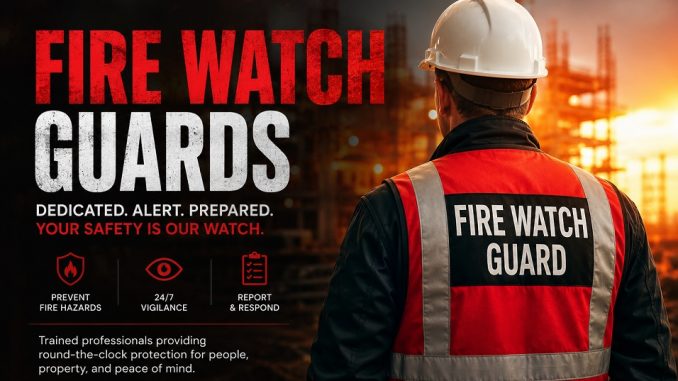
There’s a moment on every active construction site when the ordinary becomes dangerous in seconds. A welder finishes a pass, sparks scatter across dry lumber, and the crew moves on — unaware that heat is still building in a corner no one’s watching. That’s the moment that costs millions, sometimes lives. Fire Watch Guards are the trained professionals standing between that moment and catastrophe.
This isn’t a niche safety checkbox. It’s a fundamental layer of protection that savvy project managers, general contractors, and site owners are treating with the same seriousness as structural engineering. And the construction industry is finally catching up to what fire safety professionals have known for years: you can’t automate vigilance.
Why Construction Sites Are Among the Most Fire-Prone Environments on Earth
Walk any active construction site and you’re walking through a controlled experiment in combustion. Exposed framing, temporary electrical wiring, flammable adhesives, sawdust accumulation, diesel-powered equipment — these elements coexist daily in spaces where fire suppression systems are often incomplete or entirely absent.
The National Fire Protection Association has documented thousands of construction site fires annually in the United States, with losses routinely reaching into the hundreds of millions of dollars. What’s striking isn’t just the financial toll. It’s how preventable the majority of these incidents are.
Hot work — welding, cutting, grinding, torch operations — is the single largest trigger. When a welder completes a task and walks away, residual heat can smolder in adjacent materials for hours before igniting. No alarm catches that in real time. No sprinkler protects a building that doesn’t have one yet. What’s left is human judgment, trained eyes, and a disciplined protocol.
That’s exactly where a dedicated fire watch professional becomes non-negotiable.
The Real Job Description Nobody Talks About
The term “fire watch” sounds passive. It isn’t.
A trained fire watch guard isn’t just someone standing near a hazard with a fire extinguisher. They’re conducting continuous patrols, monitoring designated hot work zones for a minimum of 30 to 60 minutes after operations cease — sometimes longer depending on material conditions. They’re documenting observations, communicating with site supervisors, and making split-second judgment calls when conditions change.
The Occupational Safety and Health Administration has clear requirements: any hot work area must be monitored by a qualified fire watch for at least 30 minutes after work concludes. But compliance is a floor, not a ceiling. Experienced fire watch professionals understand that real safety means staying sharp throughout an entire shift, not just running a timer.
The best operators in this space — companies like Just Fire Watch — train their personnel to recognize not just open flame, but the early behavioral cues of fire: heat discoloration in materials, unusual odors, smoke tendrils forming in low light. That situational awareness is what separates a well-run fire watch program from a liability exercise.
What Happens When You Skip This Step
The pattern is remarkably consistent across case studies. A crew rushes to meet a deadline. Hot work gets done, someone assumes another person is watching the zone, and the team moves to the next task. Then, hours later — sometimes in the middle of the night — a fire erupts in a structure that had been progressing on schedule for months.
The fallout is brutal. Project delays measured in months, not days. Insurance claims that reshape the contractor’s risk profile for years. Investigations, potential violations, and in the worst cases, fatalities that become permanent records in safety literature.
Insurance carriers are paying attention. Increasingly, commercial construction policies are scrutinizing hot work protocols at renewal. Underwriters want to see documented fire watch procedures, training certifications, and incident logs. Contractors who can demonstrate a rigorous fire watch program are not just safer — they’re more insurable, often at more competitive rates.
The business case, separate from the moral one, is difficult to argue against.
The Standards That Govern This Work
NFPA 51B is the governing standard for fire prevention during welding, cutting, and other hot work operations. It lays out the framework: pre-work inspections, hazard identification, fire watch duration, and the qualifications expected of personnel assigned to watch duty.
OSHA 29 CFR 1926 — the construction industry standards — reinforces these requirements and adds teeth through enforcement mechanisms. A single citation for inadequate fire watch protocols can result in significant fines and, more consequentially, heightened scrutiny on every future inspection.
But here’s what the standards don’t capture: the culture required making fire watch genuinely effective. Rules describe minimums. Culture describes what actually happens when no inspector is present. The construction sites that have the strongest safety records aren’t just compliant — they’ve built environments where fire watch is treated as a professional discipline, not an afterthought assigned to whoever happens to be available.
Choosing the Right Fire Watch Partner
Not all fire watch services are built the same. As demand has grown alongside construction activity, the market has seen an influx of providers — some excellent, some operating with minimal training standards and questionable protocols.
The differentiators are worth knowing. Look for providers whose personnel have completed NFPA-aligned training, who carry appropriate licensing for the states they operate in, and who can provide documented chain-of-custody reporting for each shift. Transparency in reporting is critical — if something goes wrong, you need a defensible record of what your fire watch personnel observed and when.
Responsiveness matters too. Construction schedules shift constantly. Hot work may get added to a project scope with 24 hours’ notice. The best fire watch companies have the operational infrastructure to deploy trained personnel quickly, without sacrificing quality for speed. Just Fire Watch, which operates across major U.S. markets, has built its reputation specifically on that combination — rapid deployment backed by rigorous training.
There’s also the question of communication integration. Fire watch professionals need clear lines of communication with site supervisors, project managers, and emergency services. Companies that treat this as a siloed function — someone just standing in a corner — miss the point entirely.
The Evolving Risk Landscape in American Construction
American construction is in a peculiar moment. Labor shortages are pushing more projects to compressed timelines. Material costs have forced design adaptations that sometimes introduce unfamiliar fire behavior in newer composite materials. Urban infill projects bring hot work dangerously close to occupied structures. And modular construction — one of the industry’s fastest-growing segments — creates staging environments that are, by definition, stacked with combustible materials in various states of assembly.
Each of these trends amplifies risk. And each creates a stronger argument for investing in professional fire watch services rather than delegating responsibility informally.
There’s also the climate dimension. Hotter, drier conditions across much of the country mean that ignition thresholds — the conditions under which materials catch fire — are changing. A smoldering situation that might have self-extinguished in cooler, more humid conditions now has a higher probability of escalating. Fire watch professionals who understand regional environmental factors bring meaningful added value to high-risk projects.
When Fire Watch Becomes a Competitive Advantage
Here’s the angle that forward-thinking contractors are starting to understand: fire watch isn’t just a cost center. It’s a differentiator.
General contractors competing for high-value projects — particularly in sectors like healthcare construction, data center builds, and luxury residential development — are increasingly evaluated on their safety records as part of the bid process. Owners and developers have seen too many projects derailed by preventable incidents. They want partners who treat safety as a strategic priority, not a compliance formality.
A documented, professional fire watch program signals exactly that. It tells an owner that you’ve thought carefully about risk, that you’ve invested in personnel and process, and that you’re the kind of contractor who protects their investment. That signal has real commercial value.
The contractors winning the most sophisticated projects right now aren’t cutting corners on safety overhead. They’re using their safety investments as selling points — weaving them into proposals, highlighting certifications, and demonstrating the kind of operational discipline that sophisticated clients are willing to pay for.
The construction sites that will define the next decade of American development aren’t built on shortcuts. They’re built by teams that understand that protecting what’s being built — every single shift — is the foundation everything else rests on.